 Skip to main content
Skip to footer
Skip to main content
Skip to footer


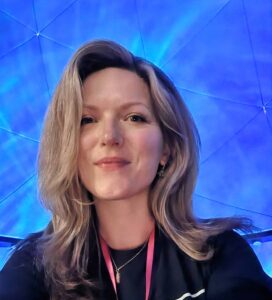
Eleanor Barrett has transformed some of the most stigmatised urban spaces into portals to alternate realities, from the Thamesmead estate to a Helsinki square associated with drug-related social problems.
Her former company The Brick Box specialised in creating immersive, participatory events that consistently reached the audiences other cultural projects struggle to engage: people from low-income households, ethnically diverse communities, and those who simply don’t believe the arts are ‘for them’.

As a working class artist herself, with over a decade working across London, The North, and internationally, Eleanor developed an intuitive approach to immersive placemaking that delivered remarkable results.
I was fortunate to work with The Brick Box when Eleanor and co-director Rosie relocated the company from London to Eleanor’s home city of Bradford in 2016, and was able to observe this magic up close. Their Wild Woods project transformed an empty and derelict former department store into an indoor forest and returned £160,000 on a £30,000 investment, bringing 3,000 people to a vacant street devoid of businesses. More importantly, it created a space where the diverse mix of Bradford audiences all felt equally at home.

It was a formula I saw her replicate over and over in Bradford, in the years leading up to the City of Culture designation. I sat down with Eleanor to discuss the key principles behind her ongoing practice, distilled from her years of experience creating immersive work with working class audiences.
Build with them, not for them
Meaningful local participation isn’t just consultation – it’s creative ownership from day one. Eleanor’s golden rule is to include the intended audience from the start, so that “it’s not just for them, it’s of them.”
At the A13 Green project in Canning Town, The Brick Box laid astroturf under a massive concrete flyover to create a village green with weekly parties. Eleanor ensured 99% of the project budget went into the local economy: security, bar staff, every band, every DJ, the kids who got involved – all local. “As soon as we started doing it, people could see the benefit,” she explains. The result was something with “all the spirit and community cross-section of a weird wedding reception.”


When Eleanor relocated to Bradford, she didn’t arrive with a predetermined vision for The Wild Woods. Instead, she invited people who “don’t consider themselves to be artists or creative” to help shape what happened in the space. “Usually when you invite them, they’ve got the best ideas because they’re fresh,” she notes. “You put it all together and it’s a nice bonkers mishmash. That’s why it’s not pretentious – it’s not pretending to be anything, it is what it is.” This authenticity combined with transparent economic benefit is a winner with otherwise hesitant audiences.
Trust your audience
People who live in stigmatised areas often battle with labels, and Eleanor consistently encountered dire warnings about the communities she worked with. Ahead of running the A13 Green events, police warned her that gangs would attack and dismantle the bandstand with angle grinders. “And, funnily enough, they didn’t!” she says triumphantly.
Their approach to antisocial behaviour was to flood the area with so much social behaviour that the problem dissipated of its own accord, often through active participation in the event.
In Helsinki, The Brick Box took over a public square long associated with drug and alcohol misuse and transformed it into Hope Springs Eternal – a spa installation with hot tubs, bubbles, water divination and music. They invited the square’s usual residents to participate fully in the wellbeing experience. Everyone joined in, completely transforming the atmosphere.

In Bradford, Eleanor pushed back against assumptions about Muslim communities: “Some people said ‘you can’t have a bar because Muslim people won’t come’. We said ‘yeah, they will’, and they did.” The Wild Woods hosted an LGBT charity, a bar, and a pop-up mosque (“a little tent with cushions in it and you could go in it and you can just chill out and talk about Islam if you wanted to”) all in the same space, without conflict.
Make it weird, not worthy
Playful irreverence is less intimidating than serious art. Eleanor discovered that taking weird art to the streets is less of a risk for projects like this than keeping it in traditional settings. Bizarre, unserious environments free people from normal social rules and cultural gatekeeping.
The Wild Woods featured a giant golden boar’s head in the centre of an indoor forest, with a paper pond and rainstorms made of rice. The setting was so absurd that it prompted childlike wonder from the audience, greasing the wheels of social cohesion.


For David Hockney’s 80th birthday celebration, The Brick Box rejected reverence entirely. Instead of a formal gallery event, she handed out platinum wigs and plastic specs to create an army of Hockneys, hired actors to portray him at different life stages, dressed as his famous sausage dog, and hosted an outdoor dancefloor full of dancing Davids. What the event lacked in tradition it made up for in numbers, coverage and memorability.
The A13 Green featured “Britain’s only Asian Elvis” and themed parties with dressing-up elements. “It’s not serious, it’s not like you look at it and think, ‘oh, that’s an art project,'” Eleanor explains. “People walking past wouldn’t be thinking, ‘oh, that’s an art project and I don’t know if it’s for me’. It’s being playful and being permeable, so people can just join in easily. It’s not like, ‘the show is over here, you’re over there’. It’s ‘let’s all be the show’.”
Create third spaces where everyone belongs
The Brick Box designs environments that don’t fit familiar cultural categories – they’re more inclusive precisely because they’re indefinable. Eleanor discovered that creating spaces that are “not a theatre, not a church, not a pub, something different” allows diverse groups to gather without the baggage of traditional venues.
The Wild Woods succeeded because it defied categorisation. “As soon as they stepped into it, they were like, ‘oh, yeah, this is our place, we know what to do in here,'” Eleanor recalls. The same derelict department store hosted real ale enthusiasts, Muslim families, LGBT communities, street drinkers, and young professionals – all finding their place in the strange indoor forest.


The A13 Green recreated the spirit of “a working men’s club vibe”. It filled a gap left by closed-down clubs, and provided social space that the area desperately needed.
Eleanor is unapologetic about including bars in arts projects: “There’s a lot of art projects, they’re quite worthy and earnest and serious, and it’s like, no, we need to have a bar because it’s social. What’s wrong with having a bar?” Understanding the importance of the inclusion of food and drink has been vital to creating experiences that keep audiences around for hours, such as the Brick Box’s work in Brixton Market in 2010 which played a part in its revival as a culinary and cultural hotspot for tourists and locals alike.
Use ritual and metaphor
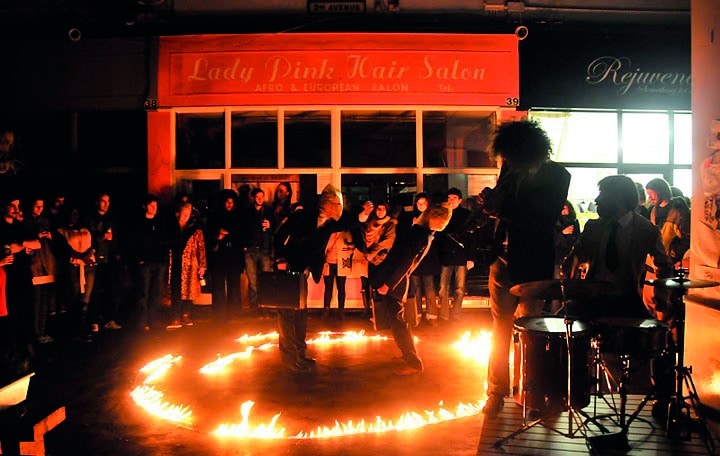
Ritual, metaphor, and attention can be more powerful (and easier to deploy) than elaborate sets. Eleanor’s Rose Garden project (also known as Rosie Rosie Rosie Rosie Lee) demonstrated this beautifully. Constructed from recycled wood and pound shop red plastic roses, it was “part build project, part maze” – an interactive theatrical experience featuring celestial gardeners.
At the heart of the Rose Garden was a tea-leaf reading ritual that bestowed metaphorical gifts. Participants would be asked “what is it that you seek?” – perhaps adventure, love, or change. Through personalised storytelling, Eleanor would describe a gift unique to them, then press the invisible gift to their top pocket. “In reality you’re not giving them anything but you’ve created an experience where they feel that they’ve been given something really special”.
Eleanor performed this ritual both at the Shunt Lounge and on a Barking and Dagenham council estate. “Considering it was previously in the context of an arty club night at Shunt, I wasn’t sure it would translate to this council estate where I was doing it in the daytime, but actually it was more powerful because people needed more.”
She discovered that “people step into the idea of ritual and magic quite easily, almost as if it’s quite a natural thing to do, as long as it’s not dressed up as black magic or anything too weird.”

Meet them where they are
If audiences aren’t coming to festivals, bring the festival to them. The Electric Fireside featured a giant fake electric fireplace – a deliberately familiar object – which toured Durham’s ex-mining communities during the Lumiere Festival and Canning Town during Light Night. The format allowed for audience participation, puppetry, dance, and storytelling, all presented in a familiar context with multi-generational appeal.
Artichoke commissioned The Brick Box to engage working class people across County Durham to create and host the storytelling experience themselves at the festival. Most of these participants had never attended Lumiere before, partly because of transport barriers. Through the Electric Fireside project, “even if they weren’t coming to the festival, the festival was coming to them”.
The bottom line
Perhaps the most important metric is the one Eleanor returns to repeatedly: authenticity. Audiences who feel genuinely seen, included and respected aren’t hard to reach at all. Just build something weird enough to be liberating, familiar enough to be comfortable, and genuinely theirs.
Eleanor is currently developing a portfolio of projects that hand the cultural reins to the people, stir up a little civic mischief, and champion the environment. Follow her work here.